
Range 01 · VISIO Pro · visual communication
Productive on rigid materials. Versatile in cutting.
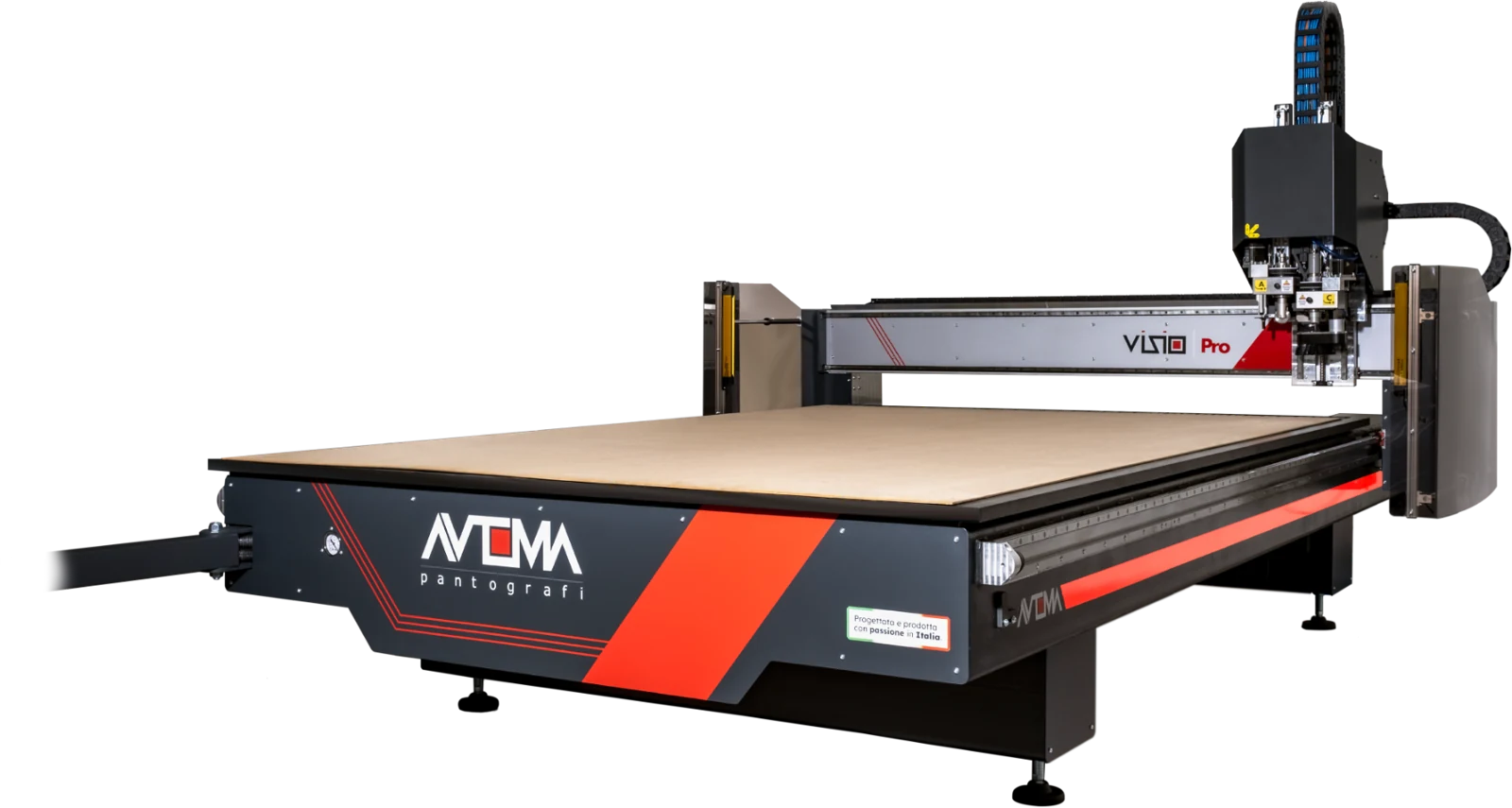
VISIO combines high-productivity routing of rigid panels with versatile knife cutting, from lightweight materials to thicker substrates. Its frame, vacuum bed and tools work together on signs, displays and exhibition fittings. Configuration is defined around your materials, with a vision system for printed work and creasing tools for compatible foldable substrates.
Overview
For investment decision-makers
The problem it solves, the effect on your business, payback, installation and future upgrades. A five-minute read.
Read more →Technical detail
For technical managers
Full specifications, construction, electronics, modules, materials and thicknesses, supplied equipment and technical videos.
View the specifications →For investment decision-makers
Your digital cutter is fully booked. Rigid-material routing is waiting.

Angelo Cava introduces VISIO: production needs and investment decisions. Video in Italian; click to play with sound.
Digital cutters are designed for fast processing of lightweight materials. On thick rigid substrates, they may need lower speeds and more passes: the limiting factor is the machine's structure, rather than the operator.
Profiled Dibond, acrylic and Forex jobs are therefore outsourced or turned down. VISIO Pro is a heavy-duty gantry router that brings rigid-panel routing in-house with print registration, alongside knife cutting and creasing for compatible substrates.
Immagine S.r.l. in Biella measured it with a stopwatch: average routing times fell to one third, and an order for 15,000 Dibond plaques was accepted. The full case study →
Figures provided by Automa based on previous installations; they vary with material, volume and configuration. We check them together on your actual work before you order.
What changes in your business
Say yes to the work you currently outsource.
- 1Bring finishing in-house
Profiled printed panels, creased displays, letters and plaques: from the same file, in the same shift, without waiting for a subcontractor.
- 2One system, three tools
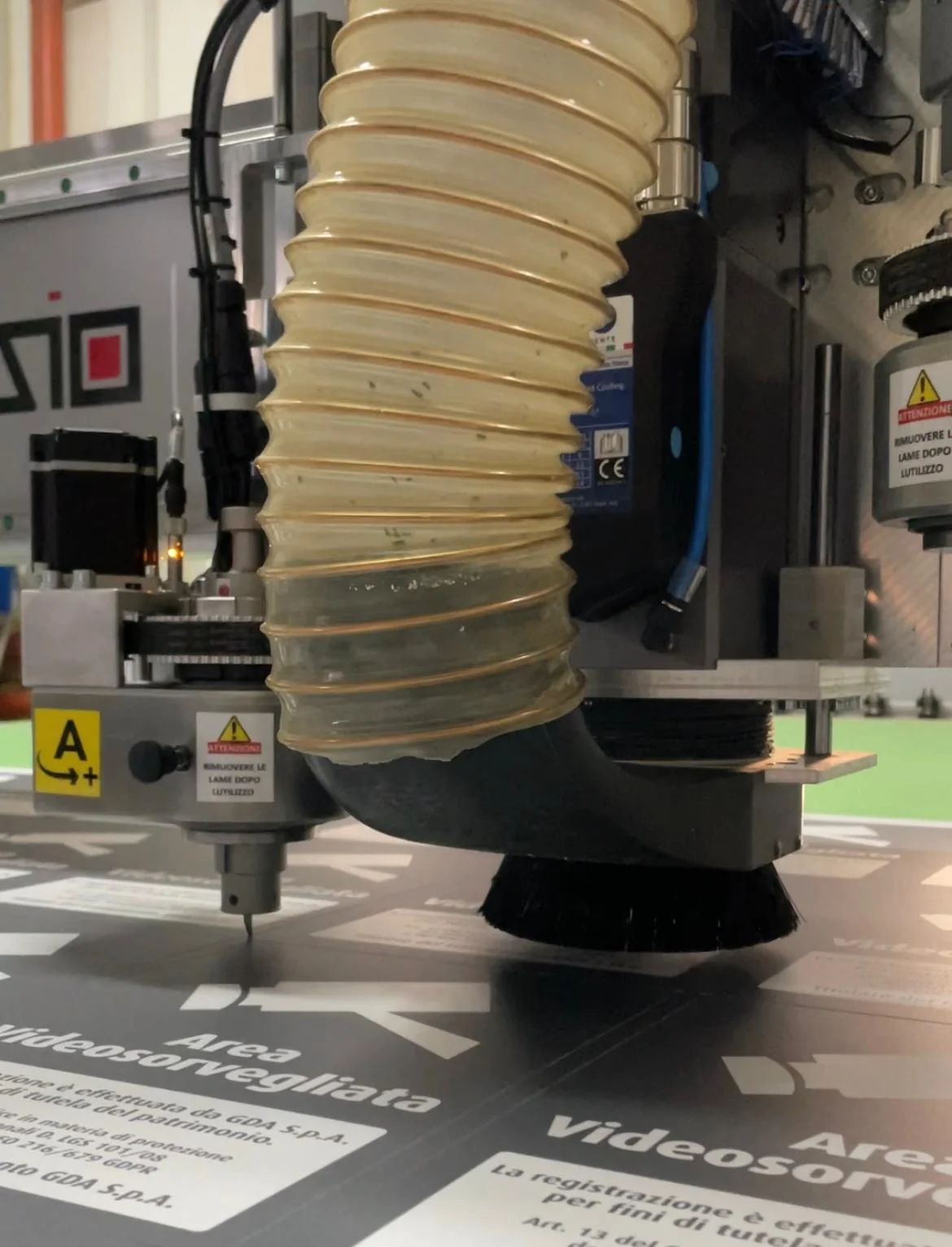
Router, oscillating knife and creasing wheel on the same head: change tools, not machines. The finished part leaves the bed ready for the next stage.
- 3Camera-controlled registration
Print registration marks guide the toolpath: cutting follows the artwork even when printing has distorted the panel.
- 4The footprint of a single router
With its safety system and multi-tool head, VISIO Pro is 3050 mm wide: the same overall width as the routing-only model.
Expand through modules
Start with the base. Add what you need when you need it.
The structure and mechanics match the fully equipped configuration: modules can be added later at your premises, without trading in the machine.
Base: routing, vacuum bed and vision
Panel profiling, engraving and pocketing with print registration.
Add the multi-tool head
Oscillating knife, fixed knife and creasing wheel: cutting and preparing folds in compatible cardboard within the same production cycle.
Add tool change and compensation
Rack-based automatic tool change, probing and volumetric compensation for fine engraving.
The vacuum bed
Productivity starts with a securely held panel.
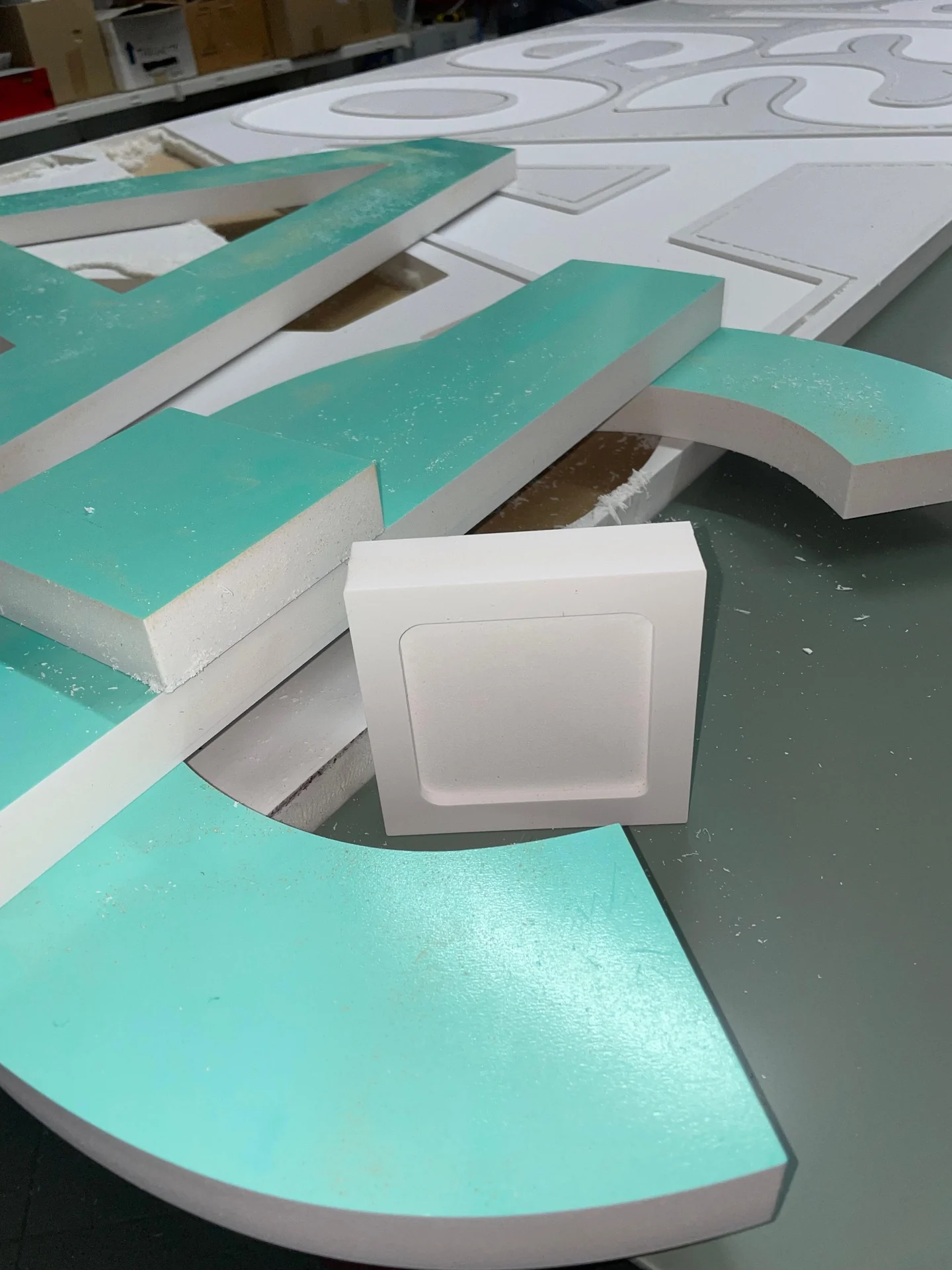
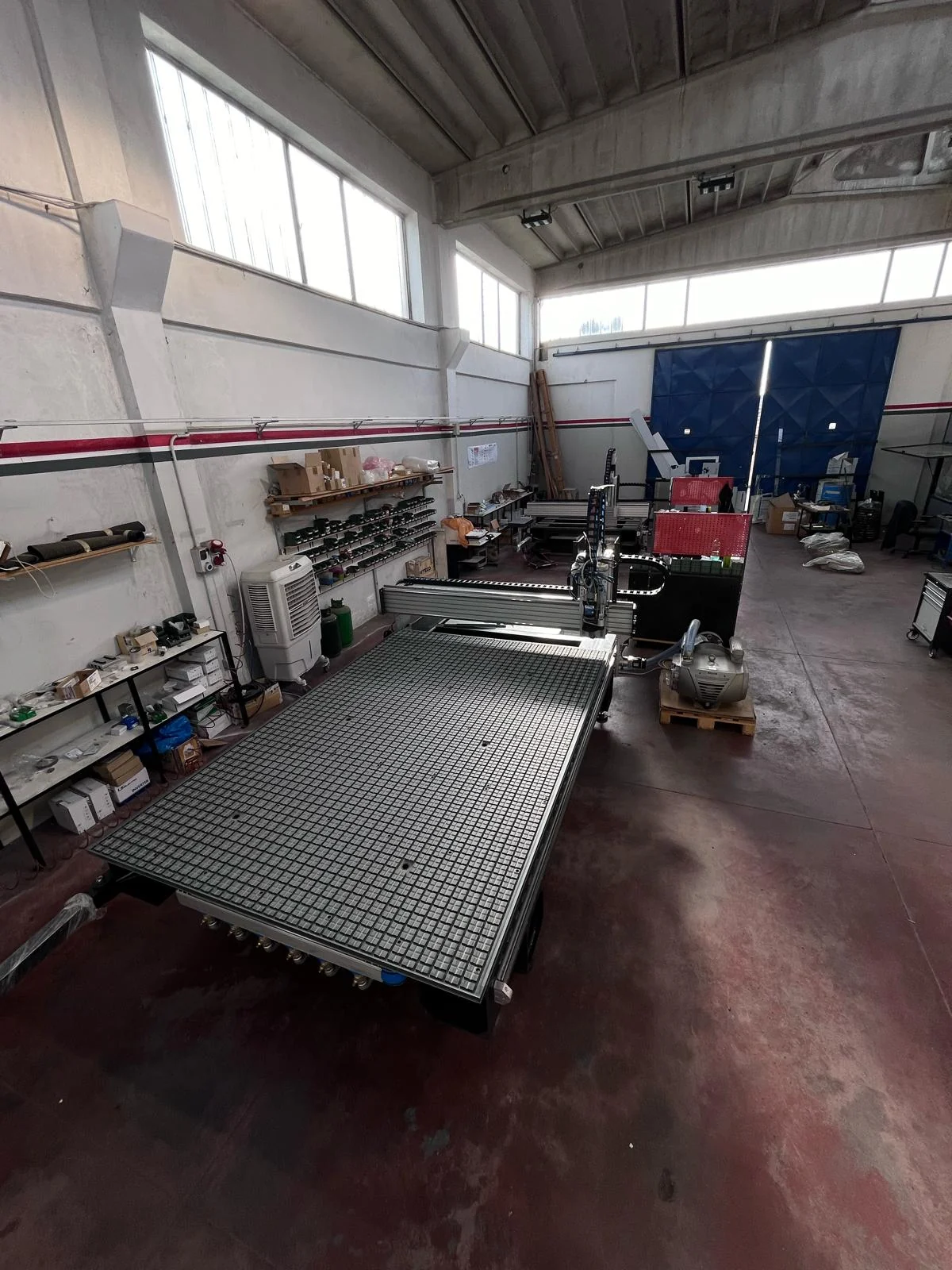
When routing rigid materials, workholding matters as much as the frame and spindle. VISIO's vacuum bed is designed to keep material stable during machining and support productivity. Its 12 software-controlled automatic zones allow vacuum coverage to be matched to the working area in use.
- 12 vacuum zones
- Automatic software control
- Hold-down for rigid-material routing
Videos
VISIO in action: machining and details.

Machining and machine details. Video in Italian; click to play with sound.

VISIO Pro in detail · six short videos


Covers are frames and thumbnails from Automa's YouTube videos; click to play.
Videos retain their original Italian audio.
For technical managers
Technical features and configuration options.
Working formats, spindles, tools and modules available for VISIO. Together we define the configuration around your materials, processes and production requirements.
Technical specifications
- Working area
- 3200 × 2050 · 4050 × 2050 mm; materials up to 90 mm thick
- Vacuum bed
- Vacuum bed divided into 12 zones, automatically controlled by software.
- Spindle
- 4.5–9 kW · up to 36,000 rpm, depending on configuration
- Vision system
- Camera and registration-mark recognition software; toolpath recalculation to compensate for substrate distortion
- Multi-tool head
- Automa design in solid aluminium and 10 mm steel plate, with two brushless-motor and encoder modules alongside the spindle
- Power consumption
- 6 kW at full load (base model) · 400 V supply · 10 bar compressed air, approximately 400 l/min with pneumatic knife
- Compliance and origin
- CE · Industry 4.0 ready · Made in Italy
Construction and electronics
- Structure
- Heavy-duty frame with 10 mm steel box sections, machined and mechanically stress-relieved; aluminium supports
- Motion system
- Recirculating-ball guides, precision helical racks and 1000 W brushless motors with two-stage planetary gearboxes
- CNC control
- Italian Ethernet CNC, up to six interpolated axes, EtherCAT drives, 1024-block look-ahead, High Speed Cutting and multi-head management for separate processes
- Component sizing
- Components sized to operate at no more than 45% of rated load
- Software
- Open CAD/CAM: Vectric VCarve Pro and Automa HMI software; imports DXF, EPS, AI, PDF, SVG and STL
Modules and options
Knives, creasing, tool change and accessories to configure VISIO for your production processes.
- Pneumatic oscillating knife
- 8–10 mm stroke, approximately 18,000 strokes/min: Forex, sandwich panels, Re-board, rubber, fluted polypropylene and cardboard up to 30–40 mm
- Electric oscillating knife
- Soft materials up to 10–12 mm: cardboard, honeycomb board, foam and carpets
- Fixed knife
- Paper, paperboard, self-adhesive materials and cardboard up to 10 mm
- Creasing wheel
- Folds and box construction in cardboard up to 10–12 mm; creasing is performed before cutting
- 45° cutting
- V-grooving in honeycomb board and Re-board up to 20 mm; interchangeable with the creasing tool
- Automatic tool change
- High-precision HSK spindles and ground collets, rack with up to ten positions (eight included)
- SCV and probing
- Probe-based volumetric compensation for fine engraving of acrylic and Dibond; automatic Z setting
- Tool cooling
- Compressed air or minimum-quantity air-oil lubrication for plastics and light alloys
- Twin-roll system
- For textiles: one fabric roll and one film roll to hold breathable materials on the bed
Materials and thicknesses
- Dibond and composites
- Profiling, grooving for folding and built-up lettering
- Forex and PVC
- Routing and knife cutting, up to 30 mm in two passes
- Acrylic and polycarbonate
- Up to 20 mm, with matt, satin or polished edges
- Honeycomb board and Re-board
- Knife cutting, creasing and 45° cutting up to 20 mm
- Wood, MDF, bamboo and plywood
- Up to 50 mm
- Aluminium and light alloys
- Routing and engraving
- Textiles, rubber and foam
- Knife cutting of up to five fabric layers; rubber and carpets up to 10 mm
Thicknesses are indicative and depend on tooling and configuration. They are checked on your material.
Processes
- Routing, profiling and pocketing
- Engraving and 2.5D machining
- 3D reliefs
- Knife cutting and kiss-cutting
- Creasing
- 45° angled cutting
- Registration-mark reading and toolpath correction
Included in the supply
- CE-marked electrical cabinet
- Operating, maintenance and operator manuals
- Licensed CAD/CAM and HMI software
- PC and 22-inch monitor
- Machine-mounted safety barriers
- Installation and training over 3–5 days
Real applications
VISIO Pro in the workshop.




Frequently asked questions
What customers ask before a material test.
How much space is required?
The space required depends on format and configuration. We check it together against your workshop layout, allowing for loading and unloading.
How does a test on my material work?
Contact us with your machining file and material details: together we will agree on testing arrangements and availability.
How long do installation and training take?
Three to five days at your premises with an Automa technician: assembly, testing on your material and operator training in Italian.
Can I start with routing only and add the knife later?
Yes. The structure and mechanics are the same: the multi-tool head, tool change and other modules can be installed later at your premises.
What does it cost?
We discuss pricing after a call to define the right configuration for your work: cost depends on format, head and modules. We support Italian customers applying for eligible incentives (see Italian incentives).
See also applications, support and Italian incentives.
Material testing
Bring us a file, a material and a target result.
Contact us with your machining file and material details: together we will agree on testing arrangements and availability.
You will speak to someone at Automa. We discuss pricing after understanding your work, rather than sending a standard price by email.
